+92 300 123 4567
Outbound outsourcing has become a practical way for companies to reach more customers, support revenue goals and run operations with better efficiency. To small business owners, it is an opportunity to reduce the cost of operation and have access to trained professionals. In the case of enterprise HR managers, it creates significant concerns about quality of the vendors, scalability, compliance and reliability over time. In the case of the operations directors, it is a method of comparing the models of services and what approach best suits the growth plans of the company.
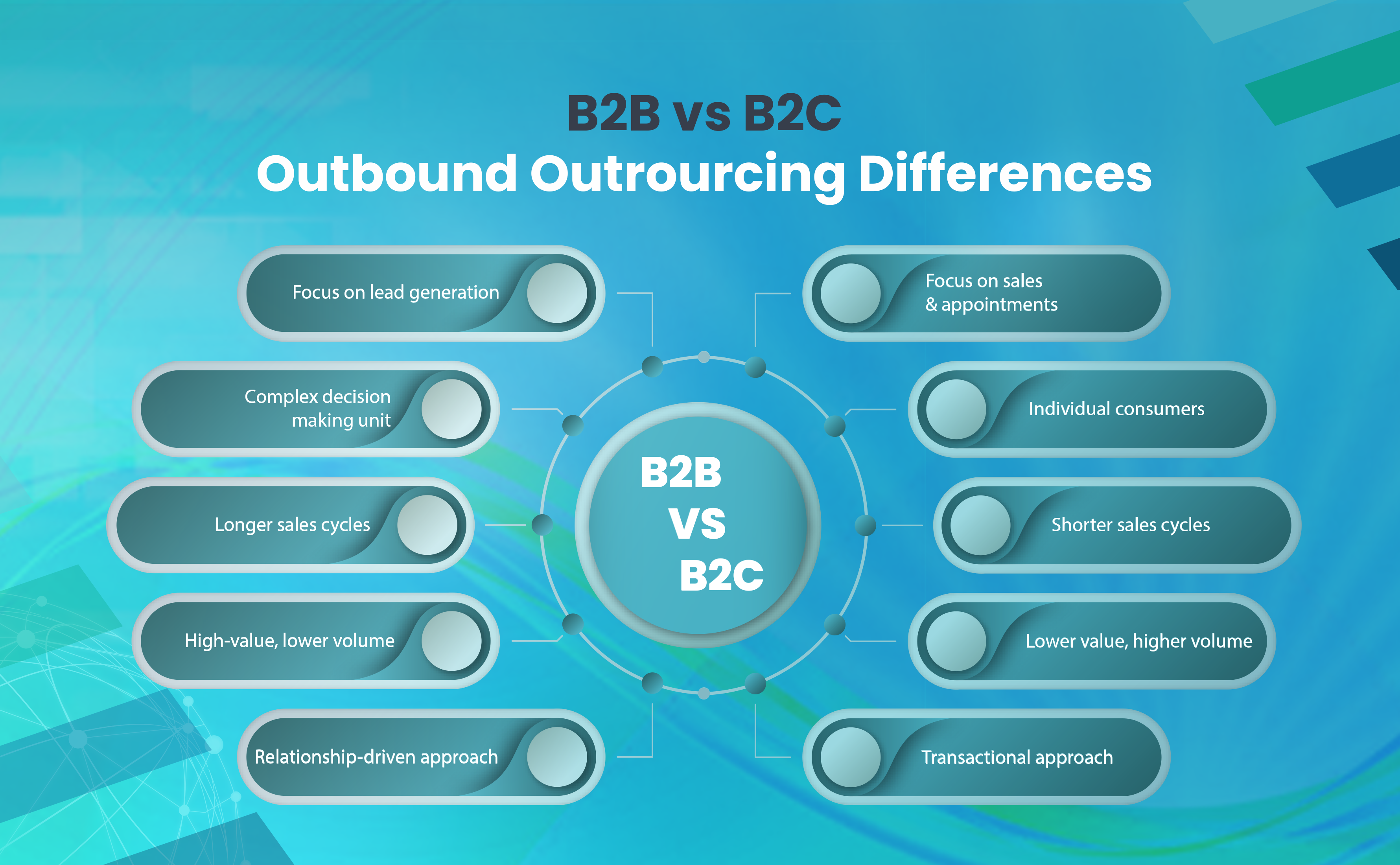
While many teams understand the value of outsourcing, fewer understand that B2B and B2C outbound outsourcing operate in very different ways. The performance of the campaign, the customers experience and the amount of expertise a business requires of its outsourcing partner is determined by the strategies used behind each model.
This guide breaks down how B2B and B2C outbound outsourcing differ, why those differences matter and how companies can choose the best approach for their goals. It is also able to provide an insight into how an experienced partner such as ITWorldBPO in Lahore, assists the two models with the appropriate talent, tools and process.
Many organizations treat B2B and B2C outbound outsourcing as if they are interchangeable. Such an error may result in the campaigns being halted, missed revenue, angered customers, and budget wastage. The fact is that these two models are based on various skill sets, working processes and technologies.
The consequences of not identifying these differences include;
Knowing the difference enables leaders to create attainable expectations, select appropriate outsourcing partner and create campaigns that reach their audience wherever they live.
Outbound outsourcing typically includes activities like:
By offloading these functions, business can cut overheads, have a more consistent operation and move internal teams into more sense-making activities. The approach, however, varies based on the type of target customer being an individual consumer or a decision maker in another company.
The following will be a breakdown of the differences of these two models and the differences in their effect on the results of companies of various size.
B2B calling also involves the need of the agent to learn about the complex organizational structures. Decision-making power may be decentralized to procurement, department heads or operations and finance. Agents have to find the appropriate contact and establish rapport and advance conversations without appearing to be pushy.
This requires:
This implies that an outsourcing firm wishing to be hired by an enterprise HR manager as a vendor will have to provide business-minded, articulate and experienced agents.
In B2C, the consumer normally is an individual with a personal choice. It is geared to the volume, rapid interaction and efficient communication.
B2C campaigns rely on:
This is a compelling factor to B2C outsourcing to the owners of small businesses due to the fact that it provides quicker returns without the need to undergo highly specialized training.
B2B outbound outsourcing deals with slower and more methodical sales cycles. The call can have stages like qualification, nurturing and arranging meetings. Closing a deal is not always the intention but to develop the opportunity.
This affects:
This is highly attentive to operations directors as the sales cycles are long and therefore the engagement with the outsourcing partner is long-term as well. Contrary to speed, quality and consistency are of greater interest.
B2C sales cycles are fast. One call can generate a sale, renewal of subscription or a survey outcome. Messaging is concerned with clarity and simplicity and emotion and not long-term building relationships.
This can be used to expand businesses with little time since the outcome is achieved sooner and expenses remain predictable.
B2B outbound work is based on correct information regarding industries, company size, job titles and company structure. Agents have to customize conversations on a lead basis.
Enterprise HR teams expect:
A seller needs to demonstrate the ability to work with detailed data, monitor the state of leads and not spend time on contacts which do not make the grade.
B2C data is usually broader. It contains demographic information, such as age, place of residence, previous contacts and purchasing habits. Although accuracy is still important, volume and segmentation are in the limelight.
It is less complicated in the case of small businesses as list generation is less costly and quicker.
B2B agents should have a credible sound to executives. They should be excellent communicators, patient, confident and industry knowledgeable.
They must:
This leads to increased conversion rates and demands additional training and a vendor with well-established operation processes.
B2C agents are concerned with speed, simplicity and emotion. They require a good tone, effective communication and capacity to resolve objections instantly.
They must:
This renders outsourcing to be cheap and scalable to small business owners.
These KPIs are the most desired by companies that count the long-term ROI since they indicate the well-being of the sales pipeline.
These KPIs give prompt feedback and assist companies in narrowing their offers.
B2B outbound outsourcing depends on advanced tools like:
This assists the operations directors to make informed decisions and monitor the entire customer life cycle.
B2C teams rely on tools such as:
These are tools that contribute to high call volumes and provide rapid insights.
Although the B2B regulations are looser than the B2C, strict rules regarding:
Enterprise HR managers will tend to seek documented evidence that the vendor is using safe practices.
B2C calling should be covered by the strict laws associated with:
Good vendors have tools that are used to ensure that these rules are automatically implemented.
Outbound outsourcing affects outcomes differently depending on whether the focus is B2B or B2C. Using the wrong strategy will undermine performance, increase expenses and decelerate development.
The impact of each model is given below.
Since the B2B agents are addressing informed decision-makers, each discourse is more strategic.
Qualified leads become more valuable deals and this is what enables companies to maintain growth.
Work in B2B is slow but the returns per conversion are normally high.
Operations directors receive clean and reliable data with structured workflows and advanced reporting.
Customers make decisions fast thus, the findings can be reflected in the sales and marketing reports faster.
Call volume and easier training mean lowering the per-lead and per-sale costs.
B2C models are far easier to scale in case a company requires an expansion in the outreach.
Renewals, follow-ups and surveys are carried out by outbound calls which assist in keeping customers loyal.
Choosing the right outbound outsourcing model depends on your goals, customer type, sales cycle and internal capabilities.
The following is a brief guideline on various positions.
B2C outsourcing can be of utmost benefit to you when:
Upon the case that your customers are other businesses and you require a constant supply of quality leads, then B2B can be the ideal.
You’ll focus on:
The type of vendor that will be the best will have good documentation, a record of experience in B2B and performance that can be measured.
You’re evaluating:
B2B may need more integration and sophisticated CRM processes, whereas B2C can be concentrated on dialers and volume control.
ITWorldBPO, based in Lahore, supports both B2B and B2C outbound outsourcing with the right tools, agents and process maturity. The company brings:
Skilled B2B and B2C teams
This will assist clients in saving money, enhancing performance and maintaining customer experience.
In case they are specialized in consumer campaigns, they might not fit an enterprise B2B pipeline.
Good training programs are an indication of a reliable vendor.
Better decisions are made off good data.
This is more with B2B where discussions are necessitated by expertise.
Decide on either hourly, per-lead or performance-based plans.
This is necessary in the extension of consumer contact as well as in the management of corporate data.
Outbound outsourcing can strengthen sales pipelines, improve customer outreach and lower operational costs. However, B2B and B2C models do not work in the same manner and they need varied strategies, skills and tools.
With the differences in the way these approaches are made, business heads will find it easy to avoid pitfalls, select the correct partner and create campaigns that have a lasting effect. ITWorldBPO favors both models through trained teams and scalable systems that assist clients to make assured decisions and achieve improved results.
An Emerging Tech Company In Dubai-UAE Delivering Innovative Software Solutions For your Business Growth
Get instant solutions for your business, drop us a message for instant help
Send